
San Mateo Criminal History Checks
Begin with the event, not a broad name search. If San Mateo police took the report, use the department’s report request process. If a person was taken into custody, check the San Mateo County Sheriff’s inmate locator. Once prosecutors file charges, search the San Mateo County Superior Court Records Index, known as MIDX. California does not offer a public name search of complete Department of Justice rap sheets. A person reviewing their own statewide history must use fingerprints through the DOJ Record Review process.
The order matters because each record is made at a different point. A police report can exist before booking. A booking can appear before a case is filed. MIDX provides index data, but it does not supply every document or guarantee that a final disposition is visible. These five steps keep a San Mateo search tied to the right custodian:
- Request the San Mateo police report through the official online, counter, mail, or fax channel.
- Use the Sheriff’s inmate locator for current custody by name.
- Search MIDX for a filed San Mateo County Superior Court case.
- Ask court Records Management for public file viewing or copies when the index is not enough.
- Use California DOJ fingerprint review only for your own statewide summary criminal history.
San Mateo Signed-Letter Rule
San Mateo Police Department requires more than a short web message for many report-copy requests. Its official instructions say an online requester completes the public records request and uploads a signed letter asking for the police report along with a copy of government-issued photo identification or a passport. Mail and fax follow the same basic document rule. That signed request helps staff connect the requester, the event, and the basis for release.
Include enough detail to identify the incident, such as the report number when known, a useful description, and the event date or location. The research does not establish that every report is open to every person. Police records can contain victim details, juvenile information, investigative material, or other protected facts, so the department may redact or withhold parts under California law.
Records at San Mateo Police
The San Mateo Police Department report page documents four request routes. The public counter is at 200 Franklin Parkway, San Mateo, CA 94403, and normal business hours are Monday through Friday, 8:00 a.m. to 5:00 p.m. In-person requesters bring government photo ID or a passport. Mail goes to that same address with a signed request letter and an ID or passport copy. Fax requests go to 650-522-7711 with the same papers.
The official request source is represented below.
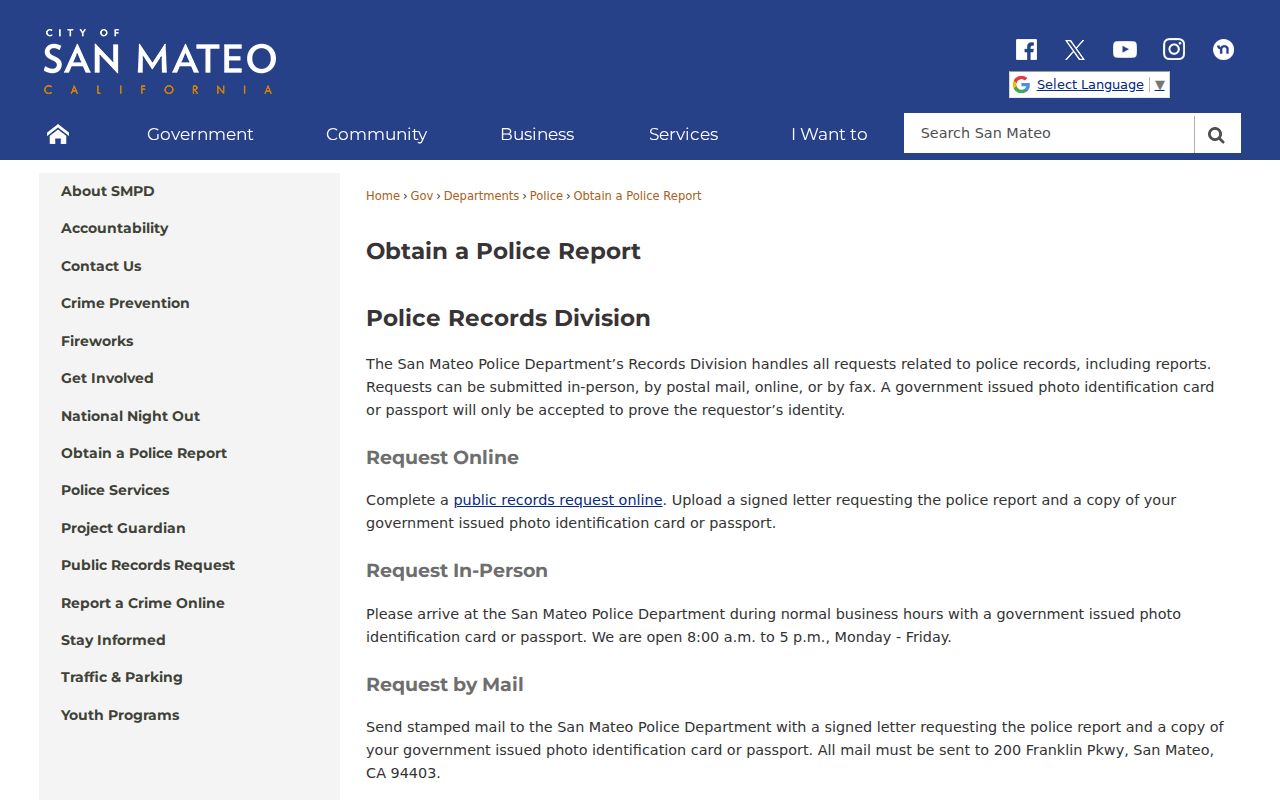
The online route is useful when the requester can upload the signed letter and ID copy. Mail provides a paper trail. Fax may be faster than postal delivery, but a clear copy and return contact details help staff route it. The department’s page, not a third-party people-search service, is the source for current instructions.
| Online | Public records request, signed letter, and uploaded government ID or passport copy |
|---|---|
| In person | Visit 200 Franklin Parkway during business hours with government ID or passport |
| Signed letter and ID or passport copy sent to the police department | |
| Fax | Signed letter and ID or passport copy sent to 650-522-7711 |
San Mateo Police Report Versus Case
A San Mateo police report and a criminal case file answer different questions. The report describes what officers recorded at the incident stage. It can contain the location, time, involved roles, officer observations, alleged offenses, property, and statements, subject to release limits. Prosecutors later decide whether to file charges. The court file then records the complaint, hearings, pleas, rulings, disposition, and sentence.
This split explains why a police report number may not work in MIDX and why a court case number may not identify the complete police narrative. For the filed charge and outcome, use the San Mateo County Court Case Lookup. For the local incident record, stay with San Mateo Police Department.
Booking and Arrest Records in San Mateo
San Mateo does not maintain a separate public city jail index for ordinary county bookings. People arrested by San Mateo police may enter the San Mateo County jail system. The Sheriff’s inmate locator is the official starting point for real-time custody by name. Maguire Correctional Facility serves as the county intake facility, while the Sheriff also operates Maple Street Correctional Center. Facility staff can route custody questions at 650-599-3000 when the locator does not settle the issue.
A booking record is not a finding of guilt. It reflects intake, the booking charge, custody status, facility, possible bail information, and later release activity if those fields are public. Prosecutor review may change a charge, and a case may not be filed. For a deeper county booking explanation, the San Mateo County Arrest Search separates agency reports, jail records, and court outcomes.
San Mateo Custody Timing
A family member may see custody data before a court case appears. Booking begins after transport to the county jail and creates its own record. MIDX begins to help only after a filing reaches Superior Court. If no case appears after a recent arrest, first confirm custody through the Sheriff, then check the court again after prosecutors have had time to act.
Do not infer dismissal from an empty MIDX result on the day of arrest. The gap can be normal workflow. It can also mean the person was cited, released, booked under a different name form, or that the case is restricted. Contact the creating office when the official tools do not match known facts.
The San Mateo Municipal Court File
San Mateo has no separate municipal criminal court for ordinary city prosecutions. City arrests and criminal citations route to the Superior Court of California, County of San Mateo. The Central Branch at 800 North Humboldt Street is within San Mateo, but the county’s MIDX system remains the public case index. Traffic matters may use a separate court traffic system. Criminal file viewing and copy access may lead to Records Management at the Hall of Justice and Records in Redwood City.
| Court Name | Superior Court of California, County of San Mateo |
|---|---|
| Case Types | Filed county felony and misdemeanor cases; traffic uses separate court tools where directed |
| Lookup | MIDX by case number, person, business, or a filing-date window |
| Index Contents | Case number, party type, case name, file date, and source of index information |
| Documents | Not supplied by MIDX; use Odyssey access information, counter viewing, or copy requests |
MIDX requires at least two characters for first and last names and allows a trailing asterisk wildcard. Its filing-date search spans no more than five calendar days. Criminal cases filed before 1993 are routed to the Criminal Court Clerk’s Office at 650-261-5100, option 1.
Why San Mateo Cases Use MIDX
California superior courts perform the county trial-court role. That structure replaced the assumption that every city has a distinct municipal criminal docket. MIDX covers public index data across several San Mateo County case types, including criminal cases, but it excludes confidential and sealed matters and does not link straight to all case documents.
Use a case number when possible. A name search can return several people or variant spellings. Compare the file date and party role before assuming a result is the sought case. If the index does not show disposition details, request the public court file rather than filling the gap with guesses.
How San Mateo Records Reach the County
San Mateo Police Department creates the incident or arrest report. When officers book a person, the Sheriff creates the jail record and routes fingerprints through law-enforcement reporting. The District Attorney decides what charges to file. Superior Court then creates the docket and case file, and final dispositions feed state criminal-history reporting.
Record flow: San Mateo Police Department › San Mateo County Superior Court › California Department of Justice
Each handoff adds new facts without erasing the older record. That is why a sound San Mateo criminal record check compares the report, booking status, and court result. DOJ’s complete statewide subject review is fingerprint-based and limited to the person whose record it is.
San Mateo ID at Every Request Path
The government ID or passport rule is the common thread across San Mateo’s police-report channels. Bring it to the counter. Copy it for mail or fax. Upload it for the online request. The signed letter accompanies all remote routes. This is a local request protocol, not proof that every requested page must be released.
Before sending a copy of identification, confirm that the destination is the official city page or listed fax and mailing address. State why the report relates to you and provide a useful return address. If police staff deny or redact material, ask for the legal basis and whether a narrower record can be released.
San Mateo Record Access Rules
California Public Records Act requests reach records held by San Mateo city agencies, but the law includes exemptions and works alongside criminal-record privacy rules. Incident and arrest material can be limited for active investigations, victim privacy, juvenile matters, confidential sources, officer safety, and other protected interests. Court sealing rules separately control access to judicial files.
Key Statutes:
California Public Records Act gives the public a process to request city records while preserving statutory exemptions.
California Penal Code section 11105 limits dissemination of state summary criminal history.
California Rule of Court 2.550 governs sealed court records and favors access unless sealing requirements are met.
Ask the office that made the record. San Mateo Police handles its reports, the Sheriff handles jail data, and Superior Court handles filed cases. That approach reduces delays and keeps a request within the correct legal framework.
Planning a San Mateo Records Visit
A request can be narrowed by time and record stage. For a same-week San Mateo event, start with police and current custody because a prosecutor may not have filed a case. For a known hearing or judgment, begin with MIDX and the court clerk. When a person needs the actual pleading, order, or sentencing minute, an index result is only a locator. Records Management holds the underlying public court material and applies its own viewing and copy rules.
San Mateo’s Central Branch does not change that custody map. Its local address is useful for court services, yet criminal cases remain county Superior Court matters. Public criminal file viewing is documented at the Hall of Justice and Records in Redwood City. Before making a trip, call 650-261-5100 to confirm the branch, file location, and current counter process. Older cases may be stored off site, and cases filed before 1993 have the special option 1 phone route.
Keep a copy of the signed police request letter and note how it was sent. A fax confirmation, mail record, or online receipt helps if staff need more detail. Do not seek every file under a common name when the goal is one known incident. A date, location, report number, and requester role help San Mateo staff find the right record while avoiding unrelated personal information.